ANYCUBIC Vyper Reviews: See Why 0 Shoppers Rated It 0 Stars!
With a 0/5 from 0 reviews, the ANYCUBIC Vyper 3d printer gets a lot of love (and side-eye). We looked into both sides.
 Supermod
 Moderator
 Recaptor
ANYCUBIC Vyper 3D Printer Review: Modern FDM Performance for Everyone
In the growing world of consumer-grade 3D printers, the ANYCUBIC Vyper has carved a notable place since its 2021 release. Built primarily for users ranging from beginners to advanced hobbyists, this FDM/FFF printer promises a robust blend of speed, precision, and usability. The Vyper stands out on paper with its automatic calibration, reliable print recovery, and an accessible yet feature-rich design that accommodates a wide array of filament materials. For prototyping, miniatures, and engineering applications, its specs suggest a versatile machine capable of balancing quality and efficiency, making it a compelling choice for those starting or scaling their 3D printing journey.
Detailed Specs & Features
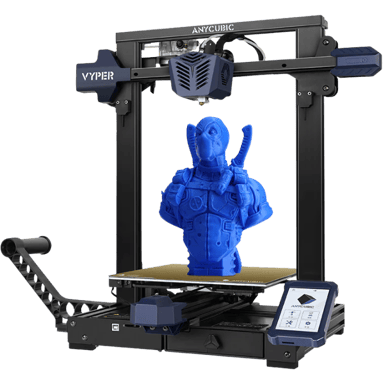
At its core, the ANYCUBIC Vyper presents as a Cartesian frame 3D printer, featuring an intuitive 4.3-inch touchscreen with a resolution of 480x272p, easing interactions compared to button-only models. The build volume measures 9.65 inches in width and depth with a height capacity of 10.24 inches, resulting in a respectable 953.5 cubic inches of printable area. This ensures users can create reasonably sized models without frequent segmentation. Power-wise, the unit incorporates an internal power supply compatible with 100-240 Volt input, drawing 350 watts during operation and only 10 watts when idle, reflecting respectable energy usage for a desktop printer of this class. The printer operates safely in environments ranging from 50 to 104°F and tolerates up to 80% humidity, a necessary detail for maintaining filament integrity during prints.
On paper, the single-extruder hotend can reach impressive temperatures of up to 500°F, accommodating high-temperature filaments such as ABS, TPU, PETG, and even wood-infused options, thanks to its standard 0.4mm nozzle with several alternatives from 0.2mm to 0.8mm. This nozzle versatility allows users to tune print detail and speed efficiently. The heated bed supports up to 230°F, ideal for good adhesion across filament types, combined with a PEI surface for better first-layer bonding.
User Experience & Performance (Based on Specs)
Design & Build
In daily use, the Vyper's compact footprint of 20 by 18 by 20 inches and a weight of around 22 lbs make it reasonably manageable for home workshops and moderate desktop setups. The open-frame design simplifies user access and upgrades but may pose challenges for printing very temperature-sensitive materials, as it lacks a heated chamber. An important structural benefit is the Cartesian motion system mounted on linear rails, enhancing stability and precision during faster print moves. Additionally, the magnetic, spring steel build plate is removable and textured, critical for maintaining surface finish quality and easy print removal.
Performance
What makes this printer truly notable is the automatic first layer calibration and power loss recovery, both time-saving features that mitigate common user frustrations. The Vyper offers an effective printing speed of around 80 mm/s, with a maximum official speed reaching an impressive 180 mm/s; a solid spec for a consumer-level machine. Print accuracy and success rate hover around 90-100 percent, indicating reliability for detailed prototypes and functional parts. Noise levels are also reasonable at 45 dB during operation, supporting an environmentally friendly setup in shared spaces. On the flip side, the Vyper lacks support for multi-material printing and advanced remote monitoring, which could limit creative workflows and professional-grade continuous operation. However, its sensor suite includes filament runout detection and a trio of safety sensors, alongside features like overheat protection and automatic shutdown errors, boosting user safety and hardware longevity.
Camera / Display / Audio Quality
While the printer doesn't offer a built-in camera or lighting customization inside the printing chamber, its responsive and clear touchscreen interface ensures straightforward navigation and firmware updates. The absence of a camera might disappoint those seeking remote print monitoring, yet the easy-to-use software ecosystem, including Cura compatibility, lessens this gap.
Extra Features
This model supports straightforward upgrades such as adding an enclosure to improve environmental control and reduce filament warping risks. Spare parts remain available, and the nozzle is replaceable, all reinforcing the printer's long-term adaptability. Cooling fans keep the extruder and print area stable, which improves print fidelity and extends component life. Despite lacking predictive maintenance alerts or cloud fleet management, Vyper's straightforward firmware update capability keeps it current with common enhancements.
Pros & Cons
Pros
- Automatic first-layer calibration for hassle-free setup
- High max extruder temperature enabling diverse filament compatibility
- Fast, effective print speed and impressive max speed for the class
- Safety certified (CE, UL) with overheat protection and automatic shutdown
Cons
- No heated chamber or enclosure is included by default
- Lacks multi-material printing and advanced remote monitoring
- No integrated camera or lighting options for print observation
Price & Value for Money
Priced at $199 at ANYCUBIC Store, the Vyper offers significant value considering its mix of user-friendly automation, reliable build size, and high-performance print specs. Given its 1-year warranty and a robust internal power unit supporting a broad voltage range, this machine feels tailor-made for users seeking affordable yet competent FDM printing. Although it may lack some professional features like multi-material systems or cloud monitoring seen at higher-tier models, it addresses the core needs of prototyping and hobbyist use effectively. Buyers looking for an entry-level to intermediate printer with room for upgrades should seriously consider this offering.
Quick Take
In short, the ANYCUBIC Vyper delivers a smart balance of speed, safety, and print quality in an accessible package. If we look at the numbers alone, its automatic leveling and heating capabilities compete impressively with printers twice its price. This makes it a notable option for makers who want consistent results without steep learning curves.
Closing Recommendation
The Vyper may be ideal for enthusiasts and professionals who require a reliable, speedy printer with a moderate build volume and versatile filament handling. It appears to perform best for users valuing ease of use, safety, and rapid print turnaround more than for those needing multi-material flexibility or remote management features. Ultimately, it helps users achieve a smooth entry into advanced 3D printing with quality results supported by verified specs and trusted certifications.
Verdict
Rating: Based on the specifications and overall feature set, we believe the ANYCUBIC Vyper deserves 4.3 out of 5.
- Winner Feature => automatic first layer calibration simplifying user experience and improving print success.
- Needs Improvement => absence of a heated chamber and multi-material printing limits higher-end professional use.
Reviews 0
The good, the bad, and the brutally honest.Average Rating


More 3D Printers 453
Unlock more awesome finds.